

It’s 8:00 PM on a Sunday. You’re three tabs deep into a Pinterest rabbit hole for middle school PBL ideas, your cold brew is actually cold (and not in the good way), and you’ve spent the last four hours trying to figure out how to make a "Bridge Building" project actually align with eighth-grade physics standards.
The "Sunday Night Blues" aren’t just a feeling; they are a warning light. They point to a workload that keeps asking teachers to do more than one job can reasonably hold. For new teachers, veteran teachers, and everyone in between, the message is often the same: be innovative, data-driven, emotionally available, standards-aligned, and endlessly adaptable. Then do it all again tomorrow.
We need to talk about sustainability. Not as a product benefit. As a professional practice. Because the truth is simple: if your teaching practice regularly depends on unpaid overtime, constant reinvention, or personal sacrifice, it is not sustainable: and eventually, it is not scalable for students, schools, or districts either.
This matters to more than one audience. Teachers need a way to protect energy and stay ambitious. Administrators need instructional models that do not burn out strong staff. Districts need systems that make deeper learning possible without turning every initiative into one more layer.
This guide is built to do what strong flagship implementation posts do: give you usable structure, not just encouragement. You’ll find research-backed context, a self-audit, a repeatable planning routine, decision rules, rollout guidance, and a quick FAQ you can actually use in a team meeting or prep period.
What the Research Says About Sustainability and Teacher Workload
Teacher sustainability is not a soft issue. It is an implementation issue.
Recent national and international research points to the same pattern: when teachers lack protected time, collaborative support, and realistic workload design, ambitious instructional models become harder to sustain.
Here are four research signals worth paying attention to:
-
Teachers are still working well beyond contract time. RAND’s “Teacher Well-Being, Pay, and Intentions to Leave in 2025” found that teachers reported working an average of 49 hours per week, about 10 hours more than contracted time. That gap matters because it turns every instructional improvement into a personal time tradeoff.
Source: RAND, 2025 -
Burnout and work-life strain remain deeply connected. RAND’s “To Make Teaching Sustainable, Help Teachers Balance Work and Personal Demands” argues that poor work-life balance, low job flexibility, and work spilling into home life are major drivers of poor teacher well-being.
Source: RAND, 2025 -
Time use is a policy issue, not just an individual habit. OECD’s “Making the Most of Teachers’ Time” and “Not Enough Hours in the Day” show that workload, administrative burden, and limited flexibility in how teacher time is structured directly shape stress, burnout, and the sustainability of instruction.
Sources: OECD, 2021, OECD, 2021 -
Collaboration is not extra: it is protective. Gallup’s “Teachers Who Collaborate, Learn at Work Are More Satisfied” found that teachers with stronger professional growth conditions, especially collaborative planning, were more satisfied and less likely to report burnout.
Source: Gallup, 2025
The takeaway is clear. Sustainable PBL does not begin with a tool or a perfect unit. It begins with a system that reduces reinvention, protects planning time, and makes ambitious teaching more repeatable.
Compare the Two Models: Heroic PBL vs. Sustainable PBL
| Dimension | Heroic PBL | Sustainable PBL |
|---|---|---|
| Planning approach | Built from scratch each time | Reuses routines, templates, and project structures |
| Time source | Nights, weekends, personal bandwidth | Protected planning time and shared workflows |
| Standards alignment | Done late or patched in | Named early and kept visible |
| Project scope | Large by default | Sized to fit time, support, and student readiness |
| Assessment load | Complex products plus complex grading | Clear checkpoints and streamlined rubrics |
| Collaboration | One teacher carries the lift | Team planning, coaching, and shared materials |
| Tool use | Multiple disconnected platforms | Small core workflow with low-friction integration |
| Long-term effect | Exciting but draining | Ambitious and repeatable |
That comparison matters because many schools mistake teacher heroics for program quality. But a model that only works when strong teachers overextend themselves is not a strong model. It is a fragile one.
Audit the Load: A Quick Sustainability Check
Before you redesign a unit, audit the conditions around your work. Sustainable PBL starts with an honest look at workload, decision fatigue, and burnout risk.
Teacher self-audit checklist
Use this quick self-audit:
- Planning Creep: Are you regularly doing more than 2-3 unpaid hours a week just to keep lessons afloat?
- Blank-Page Planning: Do you often start projects from scratch instead of adapting a structure?
- Standards Stress: Do alignment, assessment, and pacing feel like separate jobs?
- Tool Overload: Are you switching across too many platforms just to build one learning experience?
- All-or-Nothing Thinking: Do you avoid PBL unless you can make it "big enough" to feel worth doing?
- Solo Dependency: If you were absent tomorrow, would the project stall because everything lives in your head?
- Recovery Time: After a project, do you feel energized by what students made: or flattened by what it took to pull off?
How to read your results
- 0-2 checks: Your current setup may be sustainable, but protect what is working.
- 3-4 checks: You likely need stronger routines, smaller project scope, or clearer planning boundaries.
- 5+ checks: The problem is structural. Reduce reinvention first before adding complexity.
For administrators and district leaders, the same audit applies at scale:
- Are teachers expected to implement PBL without protected planning time?
- Is coaching focused on compliance instead of design support?
- Are teams collaborating around shared project structures: or inventing separately?
- Is rollout paced realistically: or announced all at once?
That is the value-first lens. Sustainable PBL is not about asking teachers to work harder with better branding. It is about building conditions where meaningful project-based learning can actually last.

When educators use reusable routines instead of heroic effort, they do more than save time. They preserve attention, patience, and creative energy for the work only humans can do: noticing students, coaching thinking, and responding in the moment.
Step-by-step: Run the audit in 10 minutes
- Choose one current or upcoming unit. Don’t audit your whole year at once.
- Mark every pressure point that applies. Be honest about where time actually goes.
- Name the biggest drain. Pick one: planning creep, scope, tools, assessment, or coordination.
- Match the drain to a fix. Example: if planning creep is high, reuse an existing project shell instead of starting from zero.
- Set one boundary for this week. Example: no project redesign after 5 PM, or one rubric reused across two sections.
- Revisit after the project ends. Ask whether the project produced student energy without costing unsustainable teacher energy.
That final step matters. A project is not truly successful if the student experience is strong but the teacher experience is impossible to repeat.
Build a Reusable Habit: The 5-Minute PBL Starter Routine
Most teachers do not need a perfect planning block. They need a reliable entry point. The 5-Minute PBL Starter Routine works because it reduces activation energy. It gives you a repeatable way to begin, capture momentum, and stop the blank-page spiral before it starts.
Step-by-step instructions
Use it exactly as written:
- Name the learning priority. Choose one standard, skill, or concept students must truly understand this week.
- Find a real context. Ask, "Where does this show up outside school?" Look local first, then school-based, then global.
- Pick a product with a purpose. Decide what students will make, say, design, test, or present.
- Set one checkpoint. Identify the next visible milestone students can reach in one or two class periods.
- Write the launch question. Draft one question that invites thinking, not just recall.
That is enough to start. Not finish. Start.
Worked examples by subject
- Middle school science: Learning priority: force and motion. Real context: a dangerous hallway traffic pattern near dismissal. Product: student redesign proposals. Checkpoint: annotated sketches with evidence. Launch question: How can we redesign movement in our school to make it safer and more efficient?
- High school ELA: Learning priority: argument writing. Real context: a proposed change to phone policies. Product: op-ed or public comment. Checkpoint: claim-evidence reasoning outline. Launch question: What makes a school policy fair, effective, and realistic?
- CTE or business: Learning priority: budgeting and market analysis. Real context: a student-run snack cart or school event. Product: pricing plan and pitch. Checkpoint: cost table with margin estimates. Launch question: How do small decisions affect whether a venture succeeds or stalls?
- Social studies: Learning priority: civic reasoning. Real context: a local development decision or community issue. Product: stakeholder brief. Checkpoint: source analysis from two perspectives. Launch question: Who benefits, who gives something up, and how should a community decide?
What this routine replaces
| Instead of spending time on… | Try this |
|---|---|
| Searching endlessly for the “perfect” project idea | Start with one learning priority and one real context |
| Mapping every lesson before you begin | Identify one checkpoint and build forward |
| Overbuilding the product | Choose one format students can complete well |
| Writing a full unit doc before testing the idea | Draft the launch question and pilot the entry point |
Notice what is missing: a 12-page unit doc, a polished slide deck, and a full assessment system before you even begin.
If you want support turning those five moves into a fuller project plan, TeachCraft can be one enabling option when it genuinely removes planning burden by organizing standards, structure, and assessment in one place. But the routine itself stands on its own. That is the point. Sustainable practice should not depend on perfect circumstances.

Choose Depth on Purpose: Decision Rules That Prevent the All-or-Nothing Trap
One of the fastest ways to burn out in PBL is to confuse ambition with quality. Teachers often feel pressure to go full-scale: public audience, interdisciplinary product, community partner, exhibition night, polished rubric, and cross-curricular buy-in: all at once.
That is not rigor. That is overload.
The better move is to choose depth or scope intentionally. Use these decision rules:
- Go narrower when time is tight. If you have less than two weeks, keep the project focused on one strong question, one product, and one core standard cluster.
- Go deeper when the payoff is clear. Add community connections or public presentation only when they strengthen the learning, not just the optics.
- Shrink the audience before you shrink the thinking. If outside experts are too hard to coordinate, let students present to peers, another class, or school staff.
- Reuse before reinventing. If a routine, rubric, or checkpoint worked once, adapt it. Do not rebuild from zero to prove creativity.
- Protect the assessment load. If the product is complex, simplify the grading categories. If the rubric is detailed, keep the product format tighter.
- Match the lift to the season. Early semester, testing windows, and high-absence periods are good times for shorter projects with clear structures. Save larger public-facing work for more stable stretches.
- End while energy is still high. A strong 6-day project that finishes cleanly beats a 4-week project that collapses under its own weight.
Quick comparison table: depth vs. scope
| If your reality looks like this… | Better move |
|---|---|
| New to PBL in this course | Narrow scope |
| Limited common planning time | Narrow scope |
| Students need routines first | Narrow scope |
| Clear standards bundle and team support | Greater depth |
| Existing checkpoint and rubric systems | Greater depth |
| Strong community connection with real payoff | Greater depth |
You can also use a simple planning filter:
Choose a lighter-lift project when:
- you are trying PBL in a new course
- your team has limited common planning time
- students need routine and structure first
- you are balancing grading-heavy weeks
Choose a deeper project when:
- the standards naturally bundle together
- students already know your workshop routines
- you have support for feedback, coaching, or public audience logistics
- the culminating work has a real purpose beyond display
This is where the Authenticity Ladder still helps. You do not have to live at the highest rung to do meaningful work.
- Step 1: The Enhanced Activity. Upgrade one task with collaboration, choice, or a real constraint.
- Step 2: The Project. Build a multi-day experience with a clear question and product.
- Step 3: The Authentic Task. Ask students to solve a real problem using real processes.
- Step 4: Community Impact. Invite stakeholders, feedback, or public use when the timing and support are there.
A sustainable teacher knows this truth: a well-run Step 2 can create real, meaningful learning. You do not need to perform transformation every week to be doing serious PBL.
Harness Real Engagement Without Carrying It Alone
When students are engaged, your job often becomes lighter in the right ways. Not effortless. But more sustainable. You stop carrying every ounce of momentum yourself.
When you implement middle school PBL ideas that actually resonate: like designing a sustainable garden for the school or creating a digital museum of local history: students can take more ownership because the work feels real, visible, and worth finishing.
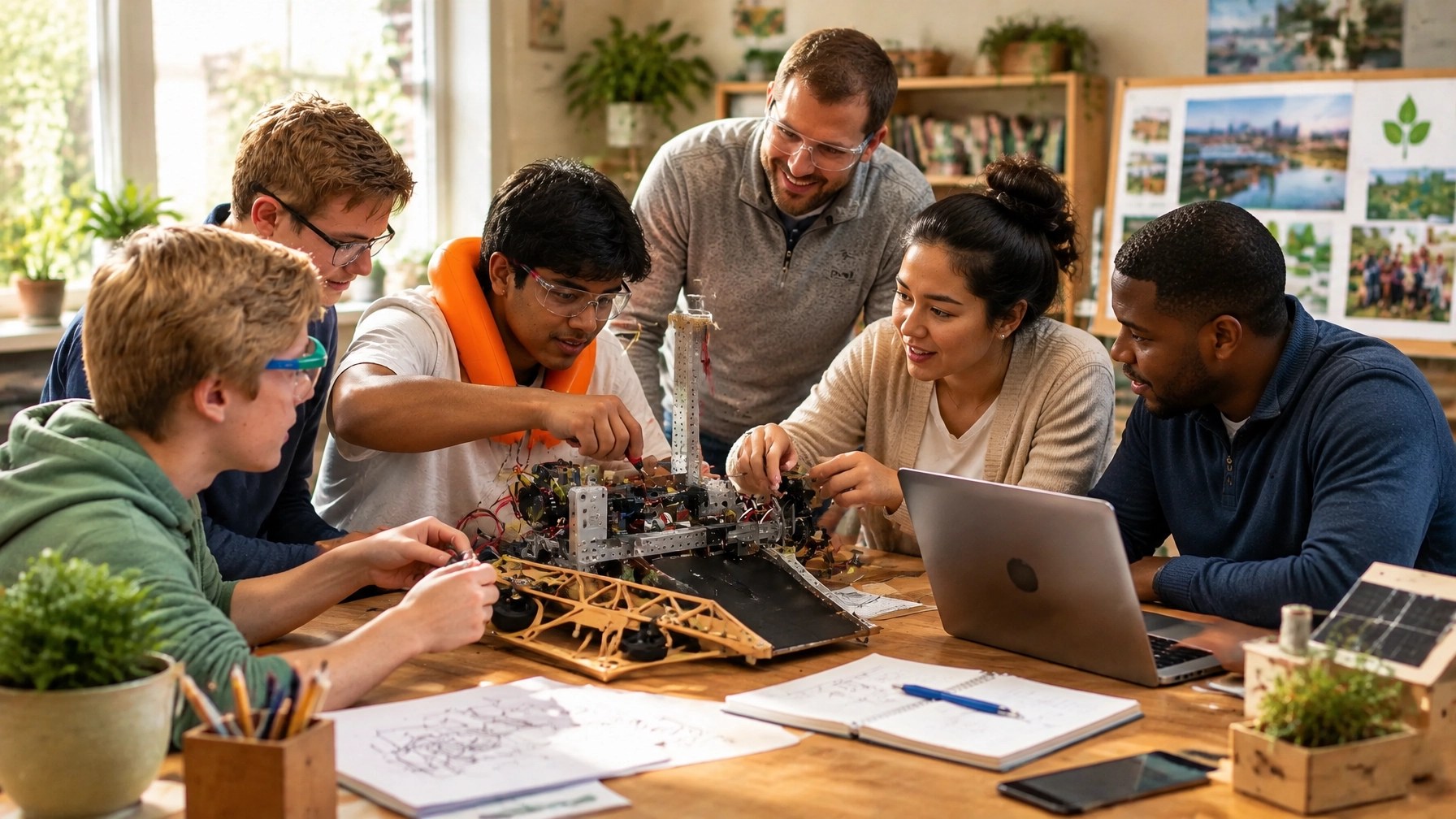
In a sustainable PBL classroom, you are not the entertainer, rescuer, and project manager of every moment. You are the architect and the coach. You set the structure, establish milestones, and make space for students to do the heavy cognitive lifting.
That shift matters for teachers. It also matters for school leaders. If a district says it wants authentic, hands-on learning, it has to build the conditions that let educators facilitate it well.
Face Tool Fatigue Honestly: Use Integration Rules That Lower Friction
We’ve all been there. A new "revolutionary" app is introduced in a staff meeting, and suddenly teachers are expected to learn one more workflow by next week. The result is predictable: scattered logins, duplicate work, and a growing sense that "innovation" mostly means more tabs.
Tool fatigue is real. And it is not solved by pretending one platform fixes everything.
A healthier approach is to use a few practical integration rules:
- Add a tool only if it replaces a step. If it does not remove planning, grading, communication, or coordination work, it is probably just adding noise.
- Keep the core workflow small. Teachers should know exactly where planning lives, where student work lives, and where feedback lives.
- Standardize by function, not by hype. Choose tools because they solve a recurring problem, not because they are new.
- Protect transferability. Your routines should still work if the app changes, the license ends, or a teammate uses something different.
- Train in context. Professional learning should happen around a real unit, real standards, and real student products: not generic feature tours.
- Measure friction. If a tool creates more clicks, more copying, or more confusion than clarity after the first few weeks, reconsider it.
Tool decision table
| Keep it if… | Reconsider it if… |
|---|---|
| It replaces a planning or grading step | It adds another place to copy information |
| It fits your existing workflow | It requires a new routine for every class |
| It improves clarity for students | It increases confusion, logins, or handoffs |
| It supports collaboration | It isolates work in one person’s account |
TeachCraft can support this kind of lower-friction planning by helping teachers build projects, align standards, and organize assessment in one place when that genuinely reduces planning burden. But it should be treated as one enabling option inside a broader sustainability strategy: not as a substitute for clear routines, protected planning time, or collaborative structures.

Build Sustainable PBL Systems: Guidance for Administrators and District Leaders
If you lead a department, school, or district, teacher sustainability cannot be left to individual resilience. It has to be designed into the system.
Start here:
1. Protect planning time
PBL asks teachers to coordinate standards, products, checkpoints, and assessment. That work needs dedicated time during the week, not just goodwill after hours. Even one protected collaborative block can reduce reinvention and improve quality.
2. Strengthen coaching
Instructional coaching for PBL should focus on unit design, student work, and facilitation moves. Avoid turning coaching into a compliance checklist. Teachers need thought partnership, not one more evaluation layer.
3. Build collaboration structures
Create shared planning templates, common project libraries, and team protocols for tuning ideas. The goal is simple: no teacher should have to invent every project alone.
4. Pace the rollout realistically
Do not ask for full implementation in every classroom all at once. Start with one course, one team, or one grade band. Pilot. Reflect. Improve. Then expand.
5. Align expectations
If leaders want deeper learning, they need to clarify what counts as success. Is it one strong project per semester? A common set of PBL routines? An exhibition cycle at specific grade levels? Clear expectations reduce guilt and guesswork.
6. Watch the workload signals
Track more than enthusiasm. Ask teachers how long planning takes, what coordination demands feel heavy, and where assessment becomes unmanageable. Sustainable systems respond early instead of waiting for burnout.
Comparison table: fragile rollout vs. sustainable rollout
| Rollout element | Fragile approach | Sustainable approach |
|---|---|---|
| Planning time | “Figure it out as you go” | Protected common planning time |
| Coaching | Compliance checks | Design support and feedback cycles |
| Materials | Every teacher builds alone | Shared templates and project libraries |
| Expectations | Full implementation immediately | Phased rollout by team, course, or grade |
| Success metrics | Number of projects completed | Quality, repeatability, and workload sustainability |
| Monitoring | Only student outcomes | Student outcomes plus teacher workload signals |
Step-by-step district rollout in four phases
- Pilot small. Start with one team, course, or grade band.
- Protect time before demanding output. Put common planning on the calendar first.
- Coach around real units. Support live planning, assessment, and facilitation decisions.
- Scale what proves repeatable. Expand only after teams show the work can be sustained without overload.
Districts that do this well create something powerful: not just isolated great projects, but a repeatable way for educators, students, and schools to do meaningful work without constant overload.
Your Practice, Your Pace, Your Next Step
You did not get into teaching to become a full-time scheduler, uploader, and curriculum assembler. You got into it to help students make sense of the world and make something meaningful inside it.
That is why teacher sustainability matters. Not because it is convenient. Because it protects the conditions for good teaching.
The path forward does not have to be extreme. Audit the load. Use the 5-Minute PBL Starter Routine. Choose depth on purpose. Keep tools few and integrated. If you are a leader, protect time, coaching, and collaboration so sustainable PBL is a system, not a solo act.
If TeachCraft helps you reduce prep and organize strong project design, use it as one support among those strategies. If another structure works better for your team, start there. The goal is not tool loyalty. The goal is sustainable, authentic learning that teachers can actually keep doing.
Your first action today: take 10 minutes and run the self-audit with your current unit or team. Circle one pressure point: planning creep, tool overload, standards stress, or all-or-nothing thinking: then choose one small fix for this week. That is how sustainable practice begins. Not someday. Today.
Frequently Asked Questions
How much PBL is “enough” to be worth doing?
More than zero, less than everything. One well-designed project in a semester can be more sustainable and more instructionally powerful than several rushed projects that overload teachers and students.
What if I only have a week or two?
Use a lighter-lift version. Keep one driving question, one product, and one checkpoint. Depth matters more than length.
Does sustainable PBL mean lowering rigor?
No. It means protecting rigor from collapse. Sustainable PBL keeps the cognitive challenge high while reducing unnecessary planning chaos, duplication, and overbuilt logistics.
What is the first thing administrators should change?
Protected planning time. Without time, every other expectation becomes one more demand placed on teacher goodwill.
How should districts measure whether PBL is sustainable?
Track both student outcomes and teacher workload signals. Ask how long planning takes, how reusable materials are, whether coaching is helping, and whether teachers can repeat the work without sacrificing personal time.
Where does TeachCraft fit, if at all?
Only where it genuinely removes planning burden. If it helps teachers organize standards, project structure, and assessment in one place, it can be useful. But it should support a sustainable system, not stand in for one.
Leave a Reply