

If you are deciding between work based learning and traditional classroom instruction, the real question is not, “Which one is better in theory?”
It is: What do my students need right now, and what can I realistically do well?
That matters because both approaches can work. Both can also fall flat.
A strong classroom lesson can build essential knowledge, confidence, and structure. A strong work-based learning experience can make that knowledge feel real, useful, and worth mastering. But if either one is poorly planned, students feel the gap fast.
This guide is here to help you make a practical decision. When should you stay in the classroom? When should you move into work-based learning? When should you blend the two?
By the end, you should be able to choose an approach, avoid overreaching, and take one smart next step.
Start with the Basics: What Each Approach Is Good At
Traditional classroom instruction is still the best tool for some jobs.
It works well when students need direct teaching, guided practice, repetition, and fast feedback. If students are learning lab safety, algebraic functions, medical terminology, or how to cite evidence in a history argument, the classroom gives you a structured place to teach those skills clearly.
Work-based learning is different. It connects learning to real or simulated workplace experiences such as internships, job shadows, school-based enterprises, client projects, clinical experiences, and employer-informed challenges.
It works well when students need to apply knowledge, solve real problems, communicate with adults, and see why the content matters beyond a grade.
The mistake is treating these as opposites.
In most strong high school programs, classroom instruction builds the base. Work-based learning creates the test of transfer.

What the Research Actually Says
A few findings show up consistently across the research.
- Jobs for the Future defines high-quality work-based learning as experiences that help students build knowledge, technical skills, and professional skills through meaningful workplace connection, not just exposure alone. Their overview is useful if you need shared language for a school or district conversation: Jobs for the Future on Work-Based Learning.
- Advance CTE emphasizes that work-based learning should be part of a progression, from career awareness to exploration to preparation and training. That matters because not every student is ready for the same kind of experience at the same time: Advance CTE Work-Based Learning Resources.
- OECD’s report on improving work-based learning in schools argues that workplace experiences are strongest when they are intentionally connected to broader academic and professional development, not treated as separate from school learning: OECD: Improving Work-Based Learning in Schools.
- Brookings Metro highlights that high-quality work-based learning can strengthen transitions to postsecondary pathways and careers, but quality and access matter. A weak placement is not the same as a strong one: Brookings Metro: Work-Based Learning.
The practical takeaway: work-based learning is not automatically better than classroom instruction. It is better for some purposes. And it works best when the academic side is not missing.
Compare the Two: A Practical Table
Use this table when your team is deciding what kind of experience to build.
| If you need students to… | Traditional classroom instruction is usually stronger | Work-based learning is usually stronger |
|---|---|---|
| Build background knowledge | Yes | Sometimes, but not as a first step |
| Learn safety procedures and non-negotiables | Yes | Only after preparation |
| Practice with teacher modeling and scaffolds | Yes | Sometimes |
| Apply learning to a real audience or task | Sometimes | Yes |
| Develop professional communication and workplace judgment | Limited | Yes |
| Keep access simple and predictable | Yes | Usually harder |
| Explore careers and build networks | Limited | Yes |
| Gather evidence of transfer beyond a test | Sometimes | Yes |
Neither model guarantees rigor. A lecture can be sharp or lifeless. A project can be authentic or chaotic.
The point is fit.
Look at Real Examples
Sometimes the fastest way to make a decision is to picture the difference.
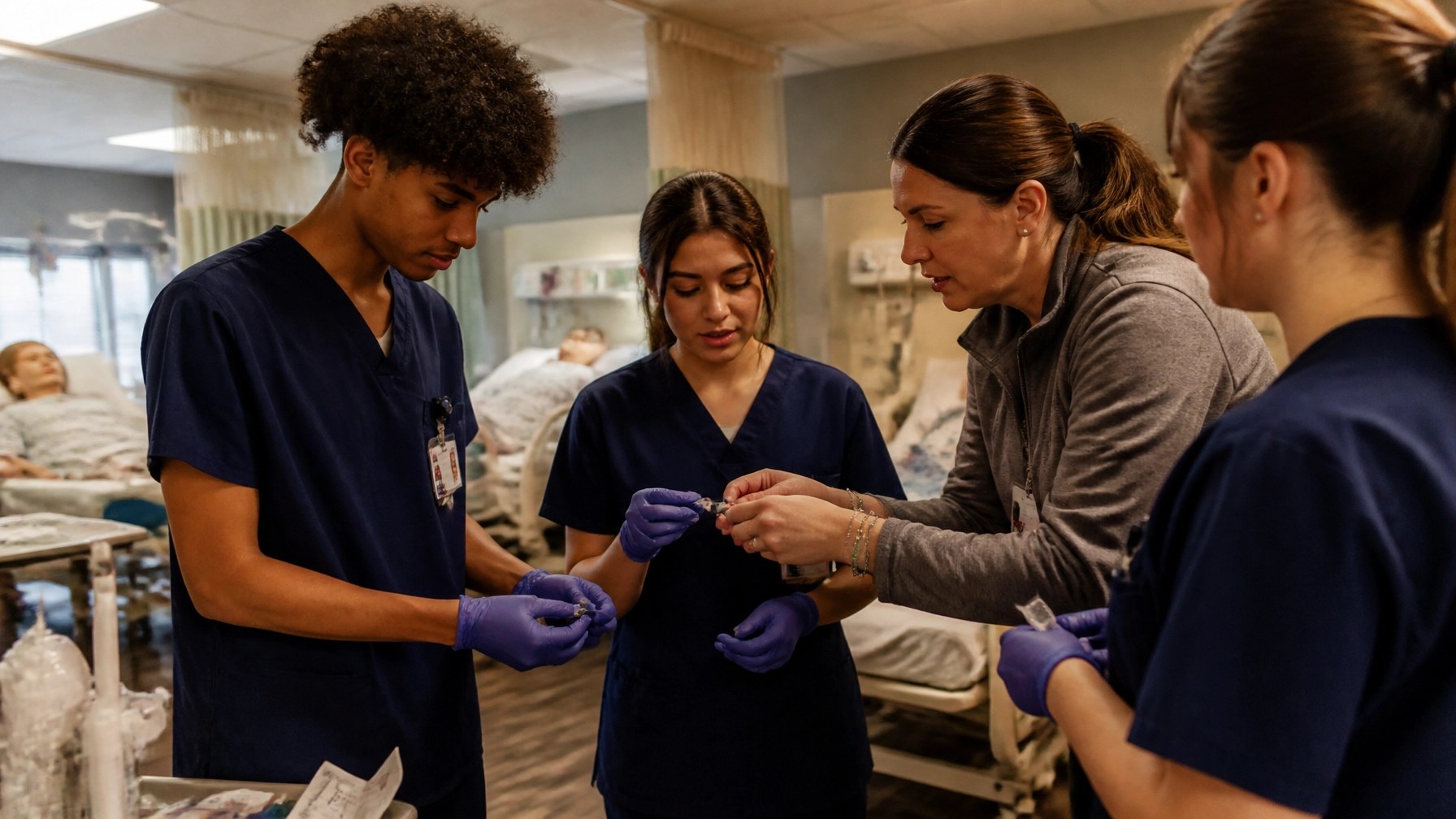
Example 1: Health science
- Classroom instruction: students learn infection control, patient privacy, medical vocabulary, and vital sign procedures.
- Work-based learning: students complete a clinical observation, practice professional communication, and reflect on how procedures work in a real care setting.
- Best choice: usually a blend. Students need the classroom first, then the real-world setting.
Example 2: Engineering or manufacturing
- Classroom instruction: students learn measurement, tolerances, tool safety, and basic design principles.
- Work-based learning: students respond to a local manufacturer’s safety or efficiency challenge, revise a prototype, and present recommendations.
- Best choice: usually a blend, especially if the project is tied to a community or industry partner.
Example 3: AP history or English
- Classroom instruction: students build historical context, analyze sources, learn annotation and argument skills.
- Work-based learning: students create a local oral-history archive, museum-style exhibit, or community-facing publication for a real audience.
- Best choice: depends on timing. Classroom first for background. WBL or community-connected application later.
Example 4: Culinary arts
- Classroom instruction: students learn sanitation, nutrition, costing, and recipe math.
- Work-based learning: students redesign a menu for a local partner, cater an event, or test recipes for a school-based enterprise.
- Best choice: blend.
Use This Decision Guide
Here is the clearest way to decide.
Use classroom instruction when:
- Students are new to the content.
- Safety, compliance, or foundational knowledge comes first.
- You need tight scaffolding and consistent pacing.
- Access barriers make off-campus or partner-based work unrealistic right now.
- The goal is skill-building before application.
Use work-based learning when:
- Students already have enough foundation to apply what they know.
- A real audience, client, or workplace problem will deepen the learning.
- Career exploration is one of the goals.
- You want students to receive feedback beyond the teacher.
- The experience will build technical and durable skills together.
Use a blend when:
- Students need both explicit teaching and authentic application.
- You want standards mastery to show up in a real product or performance.
- The project includes mini-lessons, checkpoints, reflection, and revision.
- You want broader access by combining in-class preparation with real or simulated workplace tasks.
Ask these four questions
- What do students need to know before they can do this well?
- What real task or audience would make the learning matter more?
- What barriers could keep students from participating fully?
- What can we actually support well with our current time, staffing, and partnerships?
If your answers lean heavily toward knowledge, scaffolding, and access, start in the classroom.
If your answers lean toward application, authentic audience, and professional feedback, move toward work-based learning.
If both sets of needs are true, build a blend on purpose.
Plan the Blend Without Making It Too Big
This is where many teams overreach.
They jump from a normal unit to a full internship pipeline, community partnership, public exhibition, and multi-part assessment system all at once.
Start smaller.
A strong blended experience often follows a simple sequence:
-
Teach the essentials.
Use direct instruction, modeling, examples, and guided practice. -
Introduce a real task.
Give students a workplace-connected problem, client need, or community question. -
Build in feedback.
Use teacher conferences, peer critique, mentor input, or draft reviews. -
Assess both the learning and the application.
Look at content knowledge, technical skill, communication, and reflection.
For example, a teacher might spend one week teaching water quality concepts, one week having students collect and analyze local data, and one week preparing recommendations for a community audience. That is work-based learning thinking without trying to build a full off-campus internship.
Connect the Experience to Standards
This is one reason many teachers hesitate. The idea sounds exciting, but the planning burden is real.
The simplest move is to start with the outcome, then map the standards students must use to get there.
For a community solar project, students might:
- Use algebra or statistics to analyze energy data.
- Apply physics concepts related to energy transfer.
- Research local environmental conditions.
- Interpret census or labor-market information.
- Write a technical proposal for a community audience.
- Present recommendations using evidence.
That keeps the work authentic without losing academic clarity.
If you need help organizing standards alignment, project steps, assessment tools, or local context, TeachCraft can reduce the planning burden while keeping your instructional decisions in your hands.
Connect Learning to Your Community
Local context makes projects more relevant: and more memorable.
Students can investigate:
- Regional workforce demand.
- Local employer needs.
- Community health or environmental concerns.
- Historical events and neighborhood stories.
- Census demographics.
- Transportation, housing, or economic trends.
- Small-business and entrepreneurship opportunities.
For example, a CTE program might partner with a local hospital to explore patient communication. An environmental science class could study water quality near a nearby stream. A history class could create an oral-history archive with community members. A culinary arts class could redesign a menu using locally available ingredients.
The community becomes more than a backdrop. It becomes a source of questions, data, expertise, and purpose.

Check Readiness Before You Launch
A strong WBL experience is not just a good idea. It is a coordinated system.
Teacher readiness checklist
Before launching a WBL experience, ask:
- Do students have the foundational knowledge and safety preparation they need?
- Is the learning goal clear, standards-aligned, and worth the time?
- Is there a defined audience, partner, mentor, or workplace connection?
- Are expectations for student behavior, communication, and quality explicit?
- Do students have accessible ways to participate if off-campus access is limited?
- Are transportation, scheduling, family obligations, and technology needs accounted for?
- Are reflection, feedback, and assessment checkpoints built in?
- Do you have a backup plan if a partner cancels or logistics change?
If several answers are “not yet,” a blended or classroom-first approach may be the better next step.
District leader readiness checklist
For district and pathway leaders, readiness is broader. Ask:
- Do we have enough community partnerships to avoid limiting access to a small group of students?
- Are transportation plans realistic and funded?
- Are safety protocols, liability processes, and supervision expectations clearly documented?
- Do mentors and employer partners receive training on adolescent development, communication, feedback, and inclusion?
- Do schools share common quality expectations for WBL experiences?
- Are students with disabilities, multilingual learners, rural students, and students with family/work obligations able to participate equitably?
- Do we have staff capacity to coordinate placements, troubleshoot issues, and maintain partner relationships?
- Are success measures defined beyond simple participation counts?
Readiness is not about perfection. It is about reducing friction before students carry the consequences.
Assess the Work, Not Just the Final Product
Authentic projects need authentic assessment.
A strong assessment plan may include:
- Formative checks: exit tickets, planning conferences, skill demonstrations, peer feedback, and draft reviews.
- Process evidence: journals, research notes, design iterations, meeting records, and reflection.
- Final products: prototypes, presentations, portfolios, reports, campaigns, performances, or client deliverables.
- Rubrics: clear criteria for content knowledge, technical skill, communication, collaboration, creativity, and revision.
Define success before the experience begins
A WBL experience is more likely to create real value when success criteria are visible from the start.
Look for evidence in five areas:
-
Academic alignment
Students apply targeted standards, concepts, and disciplinary skills accurately. -
Technical performance
Students demonstrate pathway-specific skills, tools, procedures, or industry practices at an appropriate level. -
Durable skill growth
Students communicate clearly, manage time, collaborate responsibly, respond to feedback, and solve problems with increasing independence. -
Authentic contribution
The work serves a real audience, addresses a real need, or produces a meaningful artifact beyond a grade. -
Reflection and transfer
Students can explain what they learned, how they improved, and where they could apply the learning next.
Sample indicators of a high-quality WBL experience
Use questions like these to evaluate quality:
- Did students know the purpose, audience, and expectations?
- Did the experience require meaningful application, not just observation?
- Did students receive feedback from both educators and workplace or community adults?
- Did all students have a viable path to participate?
- Did the experience connect clearly to academic or pathway outcomes?
- Did students leave with evidence of learning they could describe, present, or include in a portfolio?
Planning this well can take time. If your team needs help organizing standards alignment, project steps, assessment tools, or local context, TeachCraft can help streamline the planning side while keeping educator judgment at the center.

Empower Every Student to Participate
High-quality work-based learning should expand opportunity: not create another divide.
That requires more than good intentions. It requires design choices.
Strengthen equity in practical ways
Consider multiple ways for students to engage:
- Simulated workplace projects for students who cannot access off-campus placements.
- Flexible roles within group projects.
- Choice in product format.
- Accessible tools and materials.
- Virtual interviews or workplace tours.
- Community partners who reflect students’ backgrounds.
- Clear scaffolds before students work independently.
Then go further:
- Offer multiple WBL formats so access is not limited to students with transportation, free afternoons, or existing connections.
- Audit participation by subgroup to see who is getting high-value experiences and who is being left out.
- Build supports for transportation, scheduling flexibility, translation, assistive technology, and stipend needs where possible.
- Prepare mentors to avoid bias, assign meaningful work, and give feedback that supports growth rather than gatekeeping.
- Avoid relying only on informal referrals or “top student” selection methods that can narrow opportunity.
- Provide pre-teaching in professional communication, workplace norms, and self-advocacy so students are not penalized for hidden expectations.
- Include student voice when defining what feels safe, welcoming, and worthwhile in a placement or project.
District leaders can support this work by creating shared partnership agreements, transportation plans, safety procedures, mentor training, and common assessment expectations.
Equity is not an add-on. It is a quality marker. If only the most connected students can participate fully, the model needs redesign.
Start Better Conversations: Questions for Stakeholders
Strong WBL planning depends on strong conversations.
Questions for teachers and instructional teams
- What standards or course outcomes should this experience strengthen?
- What do students need to know before they engage with a workplace or community challenge?
- Which parts of this experience require direct instruction, and which parts require authentic application?
- How will we support students who need more structure, accessibility, or schedule flexibility?
- What evidence will show this experience was worth the time?
Questions for employers, mentors, or community partners
- What real problem, task, or feedback opportunity could students contribute to?
- What professional skills matter most in this setting?
- What safety, confidentiality, or supervision expectations should students understand?
- What would make student work genuinely useful rather than performative?
- How often can you realistically provide feedback or interact with students?
Questions for administrators and district leaders
- Are we building a few isolated experiences or a sustainable system?
- What barriers are preventing broader student participation right now?
- Where do transportation, staffing, safety, and partnership coordination still break down?
- How will we measure quality, not just enrollment or placement counts?
- Which school, course, or pathway could serve as the most realistic pilot?
Start small. Build momentum.
One strong employer-informed project can become a model for a pathway. One pathway can become a district-wide culture of authentic learning.
Choose Integration Over Either/Or
So, which is better for high school students: work based learning or traditional classroom instruction?
The better question is: What kind of learning experience will create the most value for students in this context?
Traditional instruction provides knowledge, structure, and guided practice. Work-based learning provides relevance, responsibility, and authentic application.
Together, they help students become:
- Confident learners.
- Capable professionals.
- Connected community members.
The future of learning is not classroom versus workplace. It is a thoughtful bridge between the two: one that honors teacher expertise, responds to local needs, and gives students meaningful work to do.
Take One Concrete Step This Week
If you are a teacher, choose one existing unit and ask: Where could students apply this learning for a real audience? Then outline one small blended experience: one mini-lesson, one authentic task, one reflection.
If you are a school or district leader, choose one course or pathway and run the readiness checklist with the team. Identify the biggest blocker: partnerships, transportation, safety, mentor training, or equity of access: and solve that one first.
Small moves count. Clearer decisions count. One better-designed experience can open the door to many more.
Less prep. More possibility. Real learning.
Leave a Reply