

It’s Sunday night. You have a strong project idea, but you still need something schools actually require: a plan that is aligned to standards, clear enough to assess, and realistic enough to teach next week.
That is where a lot of good ideas fall apart.
Not because teachers are not creative. Because standards-aligned planning asks you to do several jobs at once: unpack the standard, choose the right evidence, design a meaningful product, build assessments, and make sure the whole thing does not eat your entire weekend.
This guide is for teachers, coaches, and school leaders who want project-based learning to be rigorous without turning planning into a second job. You can use the process with your own templates, a department planning doc, or a legal pad. TeachCraft only comes in where it genuinely reduces burden, like generating aligned rubrics or helping you pull in local data.
By the end, you will have:
- a step-by-step planning workflow
- a quick comparison table to spot weak alignment
- practical examples you can picture
- research-backed planning principles with links
- a short getting started section that helps you avoid burnout
- a FAQ you can use for team conversations
Why Standards Alignment Feels So Hard
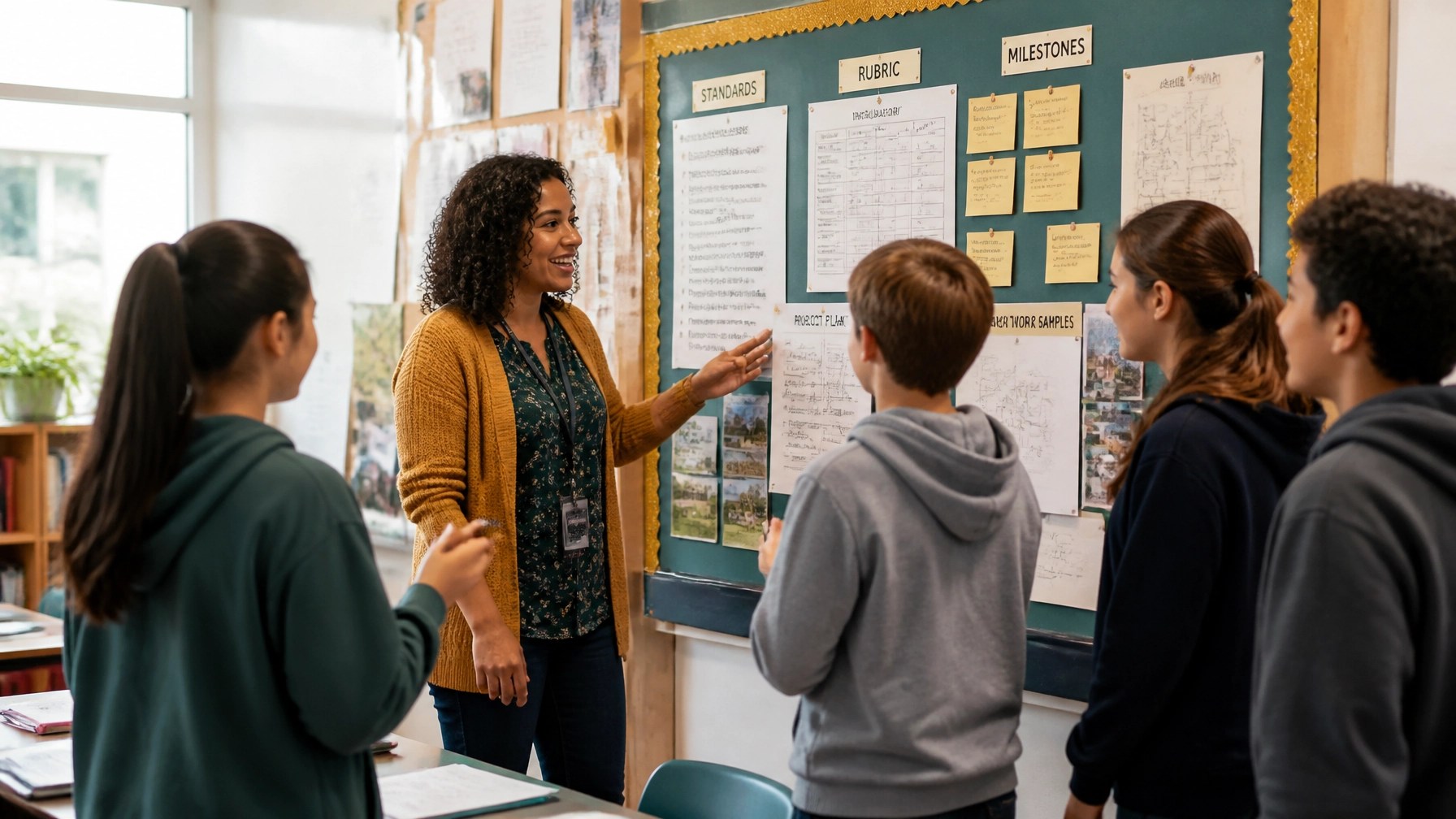
Standards alignment is rarely hard because teachers do not care about rigor. It is hard because too many planning elements have to line up at once:
- the standard itself
- the rigor inside the standard
- the evidence students will produce
- the product or performance task
- the formative checkpoints
- the final assessment
When one piece is off, the whole plan gets shaky.
Here is what that often looks like in practice:
| If planning is rushed | What happens |
|---|---|
| The project starts with a fun idea instead of a priority standard | Students stay engaged, but the academic target gets fuzzy |
| The final product is interesting but vague | You cannot clearly prove mastery |
| The rubric focuses on effort or creativity alone | Assessment drifts away from the standard |
| Milestones are missing | Problems show up too late to fix |
| Too many standards are packed into one project | Instruction gets scattered and assessment becomes messy |
That pattern shows up in both classroom practice and research. High-quality project-based learning is strongest when it is built from standards, supported with clear criteria, and paired with ongoing formative assessment. The research base summarized by Lucas Education Research and highlighted in Kappan points to rigorous, standards-built PBL as a key condition for strong outcomes: A new research base for rigorous project-based learning.
Formative assessment matters here too. Black and Wiliam’s assessment-for-learning work, summarized by ASCD, shows that students do better when success criteria are clear and feedback happens during learning, not just after it: Classroom Assessment: Minute by Minute, Day by Day.
One more useful planning insight: standards-based units are stronger when the stated curriculum, taught curriculum, and assessed curriculum are aligned before instruction begins. ASCD lays that out clearly here: Developing Well-Designed Standards-Based Units.
So the issue is not whether standards-aligned planning matters. It does. The real question is how to make it manageable.
Build a Fast, Sustainable Standards-Aligned Planning Process
Use this workflow whether you are planning one lesson, one mini-project, or a full PBL unit. The goal is simple: start with the standard, define the evidence, and only then build the experience around it.
Step 1: Choose the priority standards
Start smaller than you think.
Pick the standards students absolutely must demonstrate through this lesson or project. If you try to hit everything at once, the plan becomes hard to teach and harder to assess.
For each standard, answer four quick questions:
- What must students know?
- What must students do?
- What level of thinking is required?
- What evidence would convince me they actually learned it?
If you cannot answer those yet, do not move on.
Teacher example:
A middle school science teacher wants students to create public service campaigns about water quality. Before planning the campaign, she identifies the priority standard: students must analyze data about human impacts on ecosystems. That shifts the project from “make a poster” to “analyze local water data and make an evidence-based claim.”
Step 2: Write the driving question
The driving question should create purpose, not just decorate the unit.
Ask:
- Is it open-ended?
- Does it require students to use the priority standards?
- Could it lead to a real product or performance?
Here is a quick contrast:
| Weak driving question | Stronger driving question |
|---|---|
| What is renewable energy? | How should our community expand renewable energy without creating new environmental problems? |
| What happened in our town’s history? | Which local history story should our town preserve, and what evidence makes it worth telling? |
A better question creates clearer evidence.
Step 3: Define the evidence before the activities
This is where planning gets faster in the long run. If you define the evidence early, you waste less time building activities that do not lead anywhere.
List three kinds of evidence:
- Standards evidence: What exact thinking or skill will show mastery?
- Product evidence: What will students make, present, or defend?
- Assessment evidence: What criteria will you use to judge quality?
This aligns with standards-based assessment guidance in PBL. Edutopia’s example of standards-based assessment in project-based learning shows the value of mapping learning scales and assessments directly to standards before grading anything: Standards-Based Assessment in PBL.
Teacher example:
An AP History teacher wants students to build a local history exhibit. The product is the exhibit, but that alone is not enough. Students also need annotated sources and a written historical claim so the teacher can assess sourcing, contextualization, and argumentation.
Step 4: Match the product to the standard
Now test the product honestly.
Ask:
- Does the product require the same level of rigor as the standard?
- Can students fake completion without showing understanding?
- Do I need an added component like a written explanation, defense, or reflection?
Use this table as a quick check:
| Standard asks students to… | Product alone may not be enough | Add this evidence |
|---|---|---|
| analyze | poster, model, slide deck | written analysis, oral defense, annotations |
| argue from evidence | visual campaign, infographic | claim-evidence-reasoning paragraph or presentation |
| design a solution | prototype only | testing data, design log, revision notes |
| compare perspectives | museum display, timeline | source analysis, comparison matrix, reflection |
This is one of the biggest planning time-savers. It helps you catch misalignment before launch.
Step 5: Build milestones that protect the learning
Milestones are not extra paperwork. They are what keep the project teachable.
A typical sequence might include:
- launch and question entry
- research or investigation
- evidence collection
- draft product
- critique and revision
- final product or presentation
Each milestone should produce something visible.
Teacher example:
In a CTE class designing assistive technology solutions, milestone one might be a user-needs interview summary. Milestone two might be a design sketch tied to constraints. Milestone three might be a prototype test with revisions. Those checkpoints make the final assessment more accurate and much less stressful.
Step 6: Design assessments that match the work
Build formative and summative assessment into the plan from the start.
Include:
- quick checks for understanding
- feedback at milestones
- rubric criteria tied to standards language
- student reflection on learning and process
Research supports this approach. The Institute of Education Sciences review on formative assessment found generally positive effects on achievement, especially when feedback is used to guide teaching and learning: Formative assessment and elementary school student academic achievement: A review of the evidence.
If you want help with the heavy lift here, this is one place where TeachCraft can remove friction by generating aligned rubrics and milestone checkpoints that you can then edit with your own judgment.
Step 7: Plan instruction, supports, and pacing
Only after the alignment is clear should you build daily instruction.
Ask:
- What mini-lessons are needed?
- What models or exemplars will help?
- Where will students need scaffolds?
- What can be done in class versus at home?
- How much time does each milestone actually need?
This step protects sustainability. A plan is not strong if it looks good on paper but collapses under real classroom time.
Step 8: Review the plan like a teacher and an administrator
Before launch, do one final scan.
A teacher should be able to answer:
- What am I teaching?
- How will I know students learned it?
- Where are students likely to get stuck?
An administrator or coach should be able to answer:
- What standards are prioritized?
- What evidence will demonstrate mastery?
- How do the product, rubric, and milestones connect?
- What supports are built in?
If those answers are easy to find, the plan is likely ready.
Use This Standards-Aligned Planning Checklist

If you want a quick planning tool, use this list before you launch. If one area is missing, the plan probably needs another round of revision.
Standards-Aligned Lesson Plan Checklist
1. Driving question
Make sure the plan includes:
- one open-ended question that frames the work
- a question students can investigate, not just answer from recall
- a visible connection to the priority standards
2. Standards evidence
Make sure the plan includes:
- priority standards named clearly
- the key knowledge and skills unpacked
- specific evidence for each standard
- the level of rigor students must show
3. Milestones
Make sure the plan includes:
- checkpoints from launch to final product
- visible outputs at each stage
- room for feedback and revision
- realistic pacing
4. Products
Make sure the plan includes:
- a final product or performance with a real purpose
- a clear audience when possible
- a direct relationship between the product and the standard
- added evidence if the final product alone is not enough
5. Assessments
Make sure the plan includes:
- formative checks during the process
- a summative assessment tied to standards
- rubric criteria that match what students are learning
- some form of student reflection or self-assessment
Avoid the Most Common Misalignment Problems
Here are the mistakes that show up again and again:
| Common problem | What it looks like | Better move |
|---|---|---|
| Starting with the product | “I want students to make podcasts” | Start with the standard, then decide whether a podcast is the right evidence |
| Confusing engagement with rigor | Students are busy and excited, but the academic goal is vague | Ask what exact evidence will prove mastery |
| Packing in too many standards | The project tries to do everything | Focus on a few priority standards and assess them well |
| Grading untaught skills | Students lose points for collaboration or presentation quality they were never taught | Teach, model, and give feedback before grading |
| Waiting until the end to assess | Misunderstandings show up in the final product | Build milestone checks and revision points |
A simple team protocol can catch many of these issues early: hand a colleague the standard, the product description, and the rubric. If they cannot explain how those connect, the plan is not ready yet.
Connect Standards to Real-World Learning

Standards alignment should not flatten learning into compliance. It should make real work teachable.
The simplest way to do that is to connect the standard to a real context students can investigate. That might be local data, community history, environmental conditions, workforce trends, or a need identified by a local group.
Here are examples teachers can picture:
- Math: Students analyze local population or transportation data and recommend a community improvement.
- CTE: Students study local workforce trends and design a career-readiness resource for younger students.
- History: Students use local archives to build a public-facing exhibit or digital story grounded in evidence.
- Science: Students investigate local environmental data and present actionable recommendations.
The key is this: community relevance should strengthen the academic evidence, not replace it.
If gathering local context is the part that slows planning down, this is another place where TeachCraft can help by pulling in local data sources that teachers can adapt rather than hunting everything down from scratch.
Help Administrators and Districts Review PBL Plans Well
Strong PBL planning is not just a teacher issue. It is a systems issue.
If you are a coach, administrator, or district leader reviewing a standards-aligned plan, look for these six things:
1. Clarity
Can you quickly find the priority standards, the driving question, the product, the milestones, and the assessments?
2. Evidence of mastery
Can you point to the exact student work that will show mastery of each standard?
3. Match between rigor and task
Does the product ask students to think at the same level the standard requires?
4. Formative support
Are there checkpoints, feedback cycles, mini-lessons, and opportunities for revision?
5. Manageable scope
Is the plan focused enough to teach well, or is it trying to do too much?
6. Teacher ownership
Does the structure support quality without scripting away teacher judgment?
A common framework helps districts scale quality without forcing every classroom into the same project.
Getting Started Without Burning Yourself Out

If you are trying to make planning faster and more sustainable, do not start by redesigning everything.
Start here:
- Pick one upcoming unit.
- Choose two or three priority standards.
- Draft one driving question.
- Define the evidence students must produce.
- Add two or three milestones before writing daily lessons.
That is enough for a strong first pass.
A burnout warning: do not try to build a full-blown interdisciplinary showcase, a brand-new rubric system, and a community partnership all at once. Sustainable planning works better when you improve one repeatable piece at a time.
Frequently Asked Questions
How many standards should one project target?
Usually fewer than you think. Start with the priority standards that must be taught and assessed well. You can support related standards during instruction without making every one a grading target.
Can a lesson plan be standards-aligned if the final product is creative?
Yes, if the product is tied to clear evidence of the standard. Creative work is not the problem. Missing evidence is the problem.
What if the product does not fully show mastery?
Add another layer of evidence. That could be a written explanation, oral defense, annotation, design log, or reflection tied to the standard.
How often should I use formative assessment in a project?
Often enough to catch misconceptions before the final product. In practice, that usually means at least one check at each major milestone.
What should administrators look for first?
Start with three things: the priority standards, the student evidence, and the rubric. If those do not connect clearly, the plan needs more work.
Where does TeachCraft actually help?
Best in the parts that create the most drag: generating aligned rubrics, organizing milestones and checkpoints, and pulling in local data teachers can use to make projects more relevant without adding hours of prep.
Take the Next Step Today
Open one upcoming unit and do just this:
- highlight the priority standards
- write one driving question
- list the evidence students will produce
That small move is often enough to turn a vague project idea into a plan you can actually teach.
Request Early Access today if you want help reducing the burden of rubric creation, milestone planning, and local data gathering while keeping your own voice at the center.
Leave a Reply