

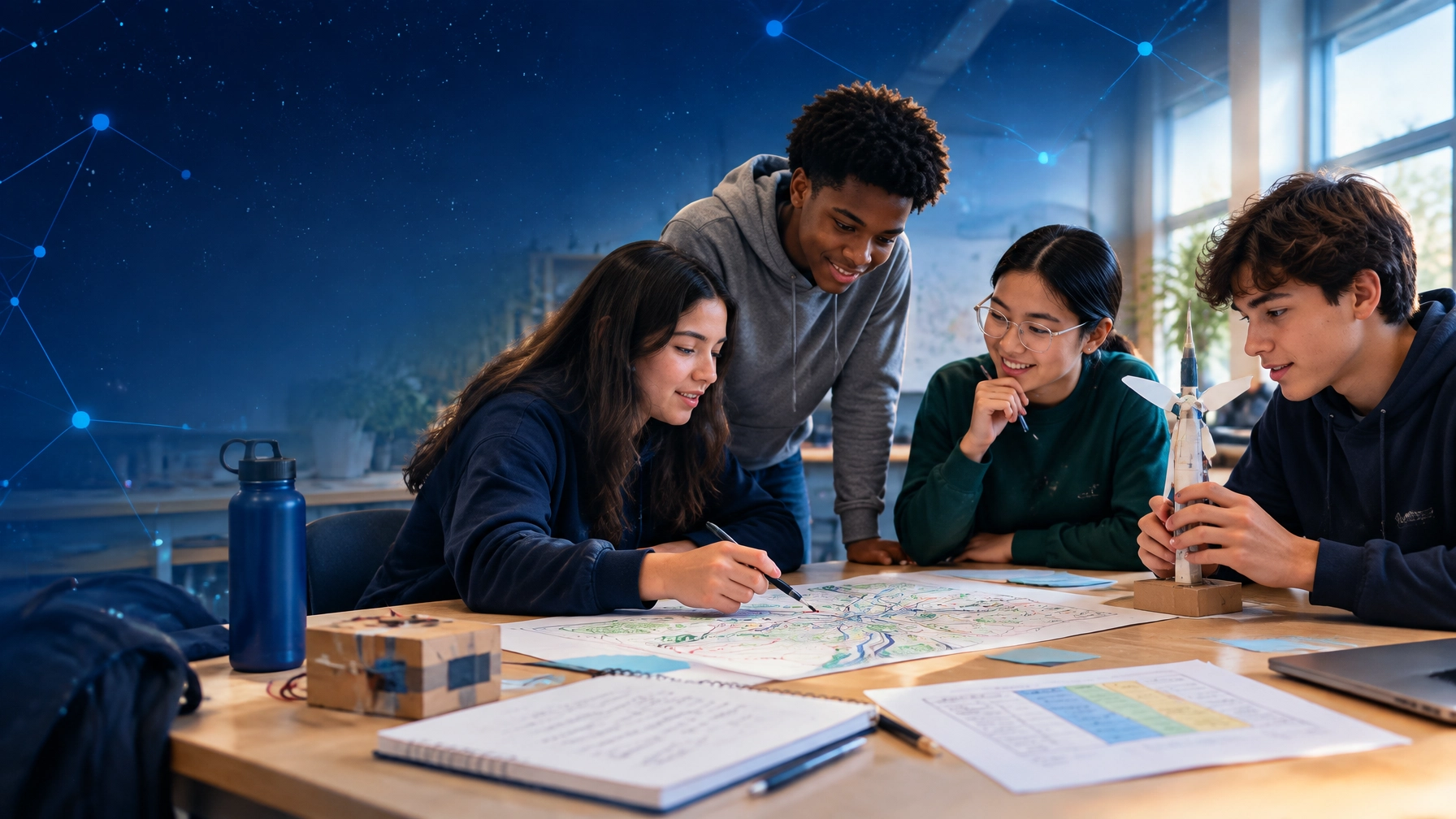
Teachers are being asked to prepare students for a future that keeps changing: while still covering standards, grading fairly, and answering emails before tomorrow morning.
That is a lot to carry.
The good news is that communication, collaboration, and adaptability do not need to become one more separate curriculum. Project-based learning gives students a reason to practice these durable skills while they learn meaningful academic content.
The key is design.
A project does not automatically build collaboration because students sit in groups. A presentation does not automatically demonstrate communication. And a difficult task does not automatically develop adaptability.
Students need clear goals, useful structure, feedback, and repeated opportunities to revise. With those supports in place, PBL can help students create real products while building the capabilities your school or district values most.
Less prep. More peace of mind. More meaningful evidence of learning.
Build a shared definition of durable skills
“Durable skills” describes capabilities that remain valuable across subjects, careers, technologies, and life situations. Common examples include:
- Communication
- Collaboration
- Adaptability
- Critical thinking
- Problem-solving
- Creativity
- Agency
- Empathy
- Self-direction
For this guide, we will focus on three skills that appear in many portrait of a graduate examples and profile of a graduate frameworks.
| Durable skill | What students practice | What you can observe |
|---|---|---|
| Communication | Explaining ideas, listening, presenting, writing for an audience | Clear claims, purposeful questions, audience-aware products |
| Collaboration | Sharing responsibility, responding to perspectives, resolving conflict | Productive roles, accountable participation, evidence of shared decisions |
| Adaptability | Revising plans, responding to feedback, using new information | Strategic changes, reflection, persistence, improved decisions |
North Carolina’s Portrait of a Graduate collaboration rubric, for example, defines collaboration through agreements, roles, cooperation, productivity, and accountability. That kind of language gives teachers and students something more useful than “work well with others.”
It gives everyone a shared target.
Connect durable skills to academic content
The temptation is to teach communication or collaboration as a generic “21st-century skills” lesson. Research suggests a stronger approach: students develop transferable knowledge by building schemas inside meaningful disciplinary contexts.
In plain language, students are more likely to transfer a skill when they use it to do something substantial.
A student does not learn adaptability by completing a worksheet about adaptability. They learn it while revising a water-quality proposal after new data changes the team’s conclusion. They learn communication while explaining evidence to a city council, client, or public audience.
This is why PBL can be a principled approach to durable skills: not merely an engaging one.
Try this alignment test
For each project, complete three sentences:
- Students will learn: the academic content or disciplinary practice.
- Students will demonstrate: the durable skill in an observable behavior.
- Students will create: a meaningful product for a real or realistic audience.
For example:
| Project element | Example |
|---|---|
| Academic learning | Analyze local water-quality data and explain cause-and-effect relationships |
| Durable skill | Communication: make a clear, evidence-based recommendation for a specific audience |
| Authentic product | A public briefing and water improvement proposal |
The durable skill supports the academic work. It does not compete with it.
Use structure to make collaboration work
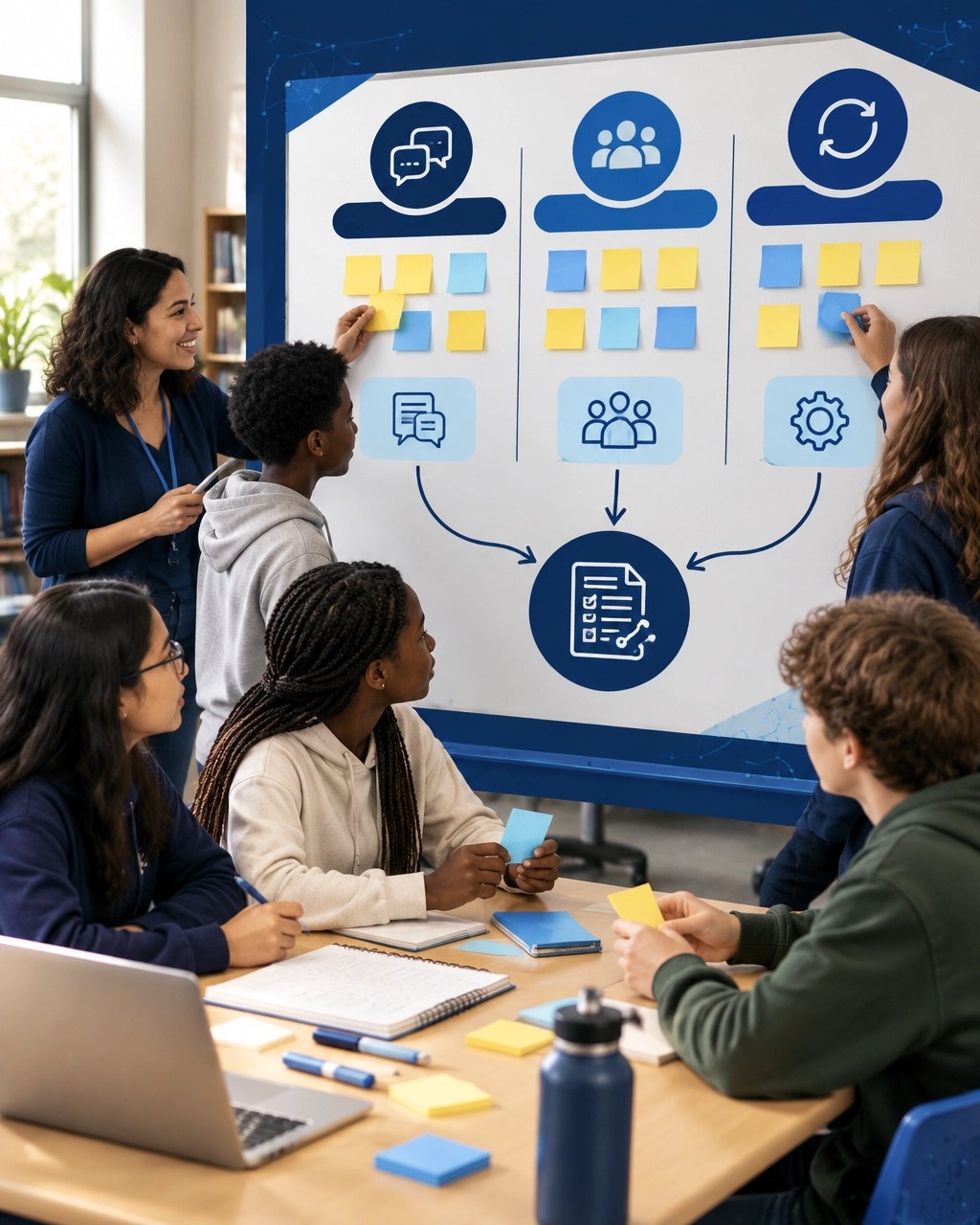
Group work often fails for predictable reasons: unclear roles, unequal participation, vague deadlines, and no process for resolving disagreement.
The solution is not to abandon collaboration. It is to structure it.
Wirkala and Kuhn’s 2011 study of problem-based learning in K–12 education found that students in problem-based conditions showed stronger delayed application of concepts than students in lecture/discussion conditions. The study also found that the difference between team and individual problem-based learning was not the main driver of the learning advantage.
That finding matters. The project structure and quality of the learning task carried more weight than simply placing students in groups.
Compare two approaches
| Unstructured group project | Structured PBL collaboration |
|---|---|
| “Work together on a presentation” | “Develop a recommendation for a defined audience using three required sources” |
| Roles are assumed | Roles are negotiated and revisited |
| One final grade | Individual and team evidence |
| Feedback arrives at the end | Checkpoints create time to adjust |
| Conflict is treated as a disruption | Conflict becomes a problem-solving opportunity |
Build simple collaboration routines into the project:
- Create team agreements.
- Assign initial roles, then rotate them.
- Schedule short progress reviews.
- Require teams to document key decisions.
- Teach a sentence stem for disagreement.
- Include individual reflection alongside the group product.
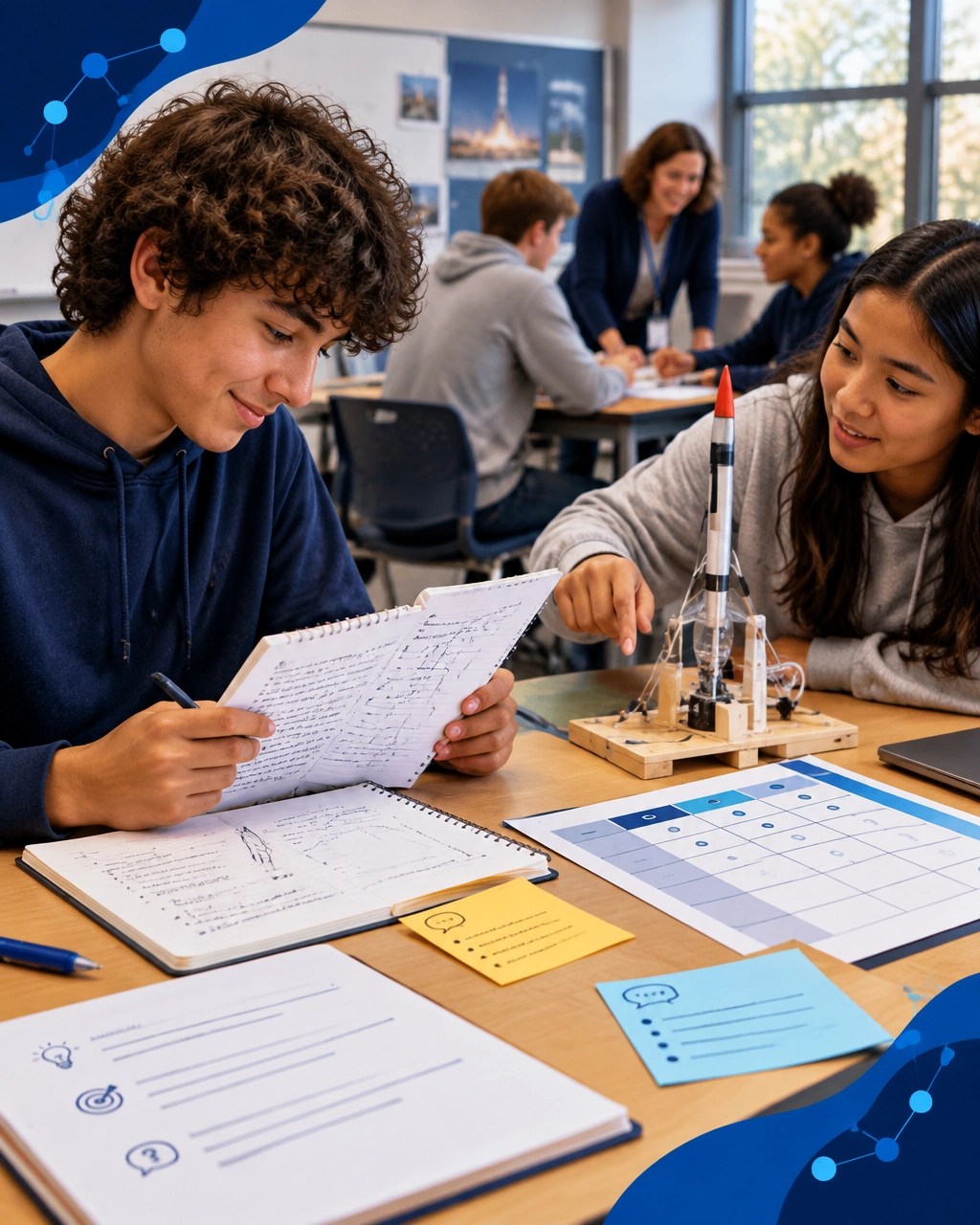
A PBL process journal template can be as simple as five recurring prompts:
- What did I contribute this week?
- What decision did our team make?
- What evidence influenced that decision?
- What challenge are we facing?
- What will we change next?
The goal is not paperwork. The goal is visibility.
Design projects that require adaptability
Adaptability is not the same as compliance. Students are not demonstrating adaptability when they simply follow a new direction from the teacher.
They demonstrate adaptability when they:
- Reconsider an assumption.
- Respond to new evidence.
- Revise a product after feedback.
- Change roles when the team’s needs shift.
- Explain why a strategy changed.
Start with a project that contains a genuine constraint or uncertainty. Consider these PBL driving question examples:
- How can our community reduce food waste without increasing costs?
- How should our town prepare for more extreme heat days?
- How can we design a safer, more accessible school entrance?
- What can historical evidence teach us about responding to a current crisis?
Then plan at least two moments when students must make a meaningful adjustment.
For a culinary arts project, teams might redesign a menu after a budget change. In environmental science, they might revise a recommendation after receiving new sensor data. In history, they might reconsider a public exhibit after discovering a missing perspective.
Authenticity creates the need for adaptability. Teacher scaffolding makes that need productive.
Assess durable skills with evidence, not impressions
Durable skills are difficult to assess when they remain broad nouns. They become assessable when you define behaviors and collect evidence over time.
Use three sources:
- Teacher observation
- Student process evidence
- Peer and self-assessment
Combine assessment methods
| Assessment source | Best evidence | Useful prompt |
|---|---|---|
| Teacher rubric | Observable behaviors during work | “How consistently does the student respond to feedback?” |
| Process journal | Decisions, revisions, and reflection | “What changed, and why?” |
| Peer assessment | Contribution and team interaction | “How did this person help the group move forward?” |
| Self-assessment | Agency and metacognition | “What would I do differently next time?” |
| Final product | Quality of communication and application | “Does the product meet the audience’s need?” |
These are practical authentic assessment examples for PBL because they assess the work students actually do: not an abstract definition detached from context.
A three-level rubric is often enough to begin:
| Criteria: Adaptability | Approaching | Meeting | Exceeding |
|---|---|---|---|
| Responds to new information | Makes changes only with significant support | Uses new information to make a reasonable revision | Anticipates implications and explains a strategic revision |
| Uses feedback | Acknowledges feedback but makes limited changes | Applies relevant feedback to improve the work | Seeks feedback, evaluates it, and uses it to strengthen decisions |
| Reflects on process | Describes what happened | Explains what changed and why | Identifies patterns and applies learning to future work |
The rubric should support feedback during the project, not merely justify a final score. These are formative assessment tools for teachers when used at checkpoints, conferences, and peer reviews.
TeachCraft can help reduce the planning burden here by generating standards-aligned rubrics and process journals from your project goals. The teacher still decides what quality means. The platform simply helps turn that intent into usable materials faster.
Follow the research: but keep the claims honest
The evidence for PBL is encouraging, but it does not say that every project works.
Zhang and Ma’s 2023 meta-analysis pooled 190 effect sizes from 66 experimental and quasi-experimental studies. They found an overall standardized mean difference of 0.441, with academic achievement at 0.650. The study also found variation based on subject, group size, class size, and implementation period.
Chen and Yang’s 2019 meta-analysis examined 30 studies involving 12,585 students and reported a mean weighted effect of d+ = 0.71 favoring PBL over traditional instruction for academic achievement.
These findings support PBL as a serious instructional approach. They do not justify treating projects as a magic solution.
Structure matters. Content matters. Feedback matters. Implementation matters.
That is also why professional learning communities matter. Durable skills develop through repeated practice and a shared language across classrooms. A teacher team can calibrate rubrics, examine student work, and identify where students need more modeling.
A tool can reduce planning and assessment workload. A community changes practice.
Launch a durable-skills project in five steps
1. Choose one graduate competency
Start with one skill connected to your district’s portrait or profile of a graduate. Avoid assessing everything at once.
2. Define two or three observable behaviors
Replace “students will collaborate” with “students will share responsibility, respond to peer ideas, and document team decisions.”
3. Design the academic challenge
Use standards, teacher intent, and local context to create a project with a meaningful audience and product.
4. Add feedback checkpoints
Build in a launch conference, a midpoint review, peer feedback, and a final reflection.
5. Review evidence with colleagues
Bring one rubric, two process-journal entries, and one student product to your PLC. Ask:
- What evidence shows growth?
- Where did students need more scaffolding?
- Did our rubric describe quality clearly?
- What will we change in the next cycle?
You do not need a perfect project to begin. You need a repeatable cycle.
Getting Started: a 30-minute planning sequence
If your planning time is limited, try this:
- Minutes 1–5: Select one durable skill and one academic standard.
- Minutes 6–10: Write an authentic question and identify an audience.
- Minutes 11–15: Define three observable behaviors.
- Minutes 16–20: Choose one product and two checkpoints.
- Minutes 21–25: Draft a simple rubric.
- Minutes 26–30: Decide what students will record in their process journals.
You can build the full project later. Start with a clear reason for students to communicate, collaborate, and adapt.
Frequently Asked Questions
What are durable skills?
Durable skills are transferable capabilities that remain valuable across changing contexts. Communication, collaboration, adaptability, critical thinking, creativity, and agency are common examples.
How does PBL develop durable skills?
PBL gives students repeated opportunities to use durable skills in meaningful academic contexts. Students communicate for an audience, collaborate to create a shared product, and adapt when evidence, constraints, or feedback change.
Should durable skills be graded?
They can be assessed when they are defined as observable behaviors. Use rubrics, process journals, peer assessment, self-assessment, and teacher observation rather than relying only on a final product.
What is the difference between a portrait of a graduate and a profile of a graduate?
A portrait of a graduate usually describes the competencies a community wants students to demonstrate by graduation. A profile of a graduate may serve a similar purpose, often using a district-specific set of outcomes, indicators, or learner attributes. The names vary; the implementation challenge is the same: make the competencies visible in daily learning.
Do I need a project based learning lesson plan template?
Not necessarily. A template can help organize thinking, but strong PBL begins with standards, student needs, context, an authentic question, and evidence of learning. A flexible planning tool can be more useful than a fixed project based learning lesson plan template because it adapts to your intent.
What is one easy place to start?
Choose one upcoming unit and add a single durable-skill target. Define what students should do, collect evidence during the process, and discuss the evidence with your PLC.
Durable skills are not an extra layer placed on top of learning. They are developed through the meaningful work of learning: when students investigate, create, explain, revise, and contribute.
Your expertise sets the direction. Your students do the real work. With the right structure and a supportive professional community, PBL can help that work hold up long after the final presentation.

Leave a Reply